
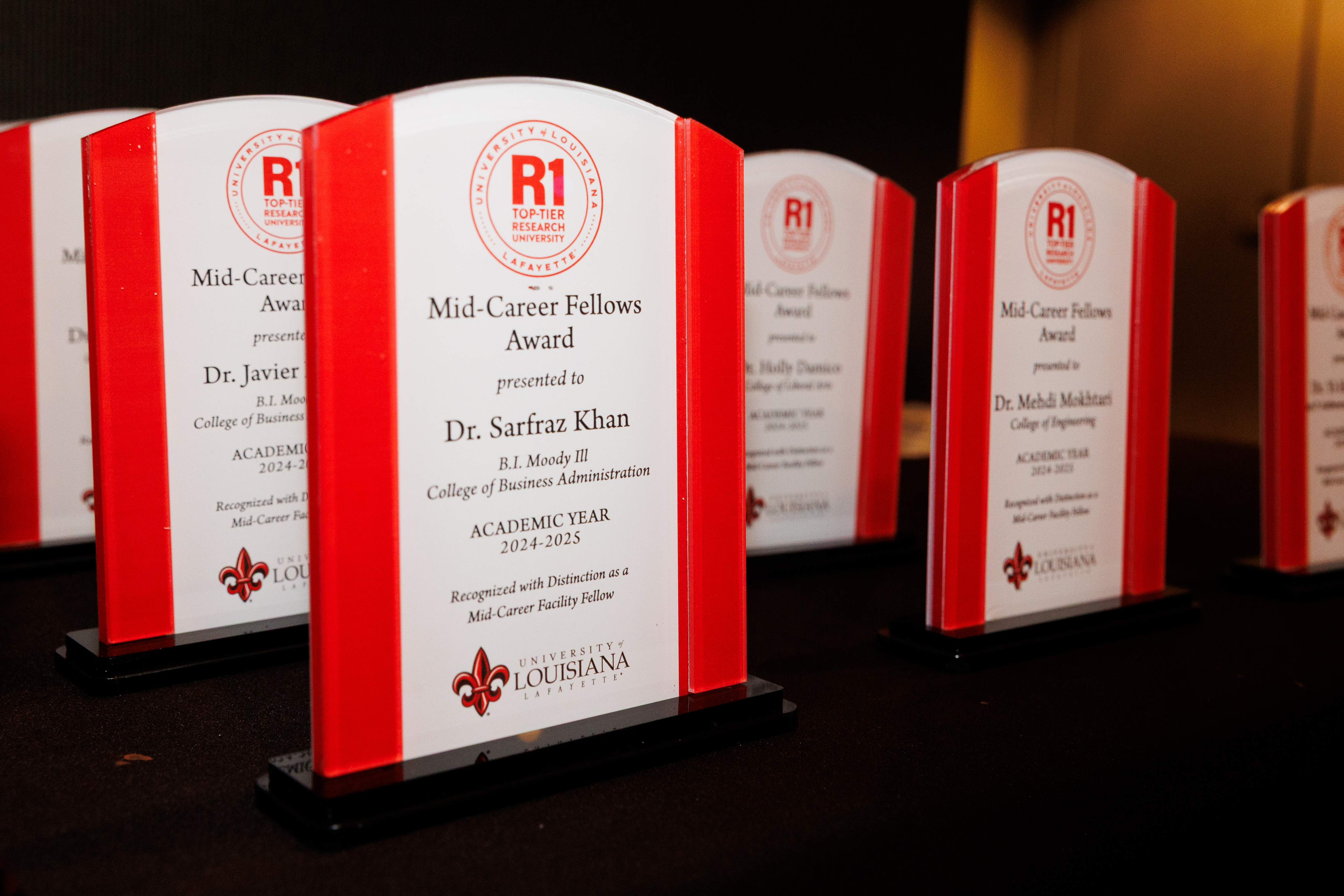
We are proud to celebrate the outstanding achievements of our faculty, whose dedication to advancing research, fostering innovation, and mentoring the next generation continues to elevate our center’s impact.
We are proud to celebrate the outstanding achievements of our faculty, whose dedication to advancing research, fostering innovation, and mentoring the next generation continues to elevate our center’s impact.
Dr. Rafael Hernández is a Distinguished Professor Award Recipient for the Eminent Faculty Awards in 2026.
Dr. Mark Zappi, professor in the College of Engineering at the University of Louisiana at Lafayette, is the recipient of the 2026 Louisiana Engineering Foundation Faculty Professionalism Award.
The University of Louisiana at Lafayette has joined the South Central Climate Adaptation Science Center (CASC) as a full consortium member, strengthening its role in collaborative research on climate-related challenges, regional resilience, and technological adaptation across the Gulf Coast.
The South Central CASC is part of a national network supported by the U.S. Geological Survey (USGS). The partnership connects universities, federal researchers, natural resource managers, and communities to develop actionable science that regional decision-makers rely on to respond to evolving climate and environmental demands.
"It's clear the University of Louisiana brings deep expertise and a strong commitment to partnership," said Kris Metzger, acting regional administrator for the South Central CASC/USGS. "They are an incredible addition to our consortium, and we're thrilled to welcome them to the South Central CASC."
As part of UL Lafayette's multidisciplinary engagement in the consortium, key researchers from the Energy Institute of Louisiana (EIL) are actively contributing their expertise in sustainable energy, chemical processes, emissions reduction, and clean resource development:
Executive Director, Energy Institute of Louisiana; Chevron Professor of Chemical Engineering
Head of the Department of Chemical Engineering; EIL Research Leader in Alternative Fuels and Catalysis
Assistant Professor of Chemical Engineering; EIL Research Specialist in Sustainable Materials and Bioproducts
Dr. Emad Habib, professor in the Department of Civil and Environmental Engineering and director of the Institute for Coastal and Water Research (ICaWR), serves as the University's site lead for the consortium. Additional co-principal investigators include:
"Joining the South Central CASC as a consortium member provides an important new platform for connecting the University's research strengths with decision-makers across our region," Habib noted. "It gives our faculty and students opportunities not only to participate in collaborative research, but also to help shape research questions around some of the most pressing environmental and climate challenges facing Louisiana and the South Central region."
The University recently hosted South Central CASC and USGS leaders for a daylong campus visit to review laboratories, pilot-scale testing sites, and research centers. Consortium Director Renee McPherson highlighted the impact of the five-year agreement:
"On our visit to UL, we saw the depth and breadth of their research team. We know UL's contributions over the next five years will bring needed science to decision makers in Louisiana and across our region."